



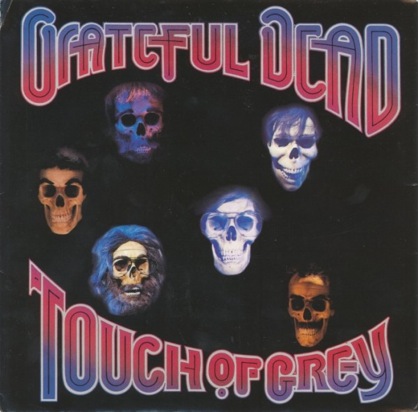



On June 19, 1987—25 years ago this week—MTV showed the video of the Dead’s just-released single, “Touch of Grey,” for the first time. You’ve all seen it: Life-size skeleton marionettes decked out like each band member (complete with facial hair!) mime the song before an enthusiastic Dead Head crowd—it was shot at Laguna Seca (Monterey, Calif.) the night of May 9, a few hours after the first of two weekend Dead shows there. In the video, which was conceived and directed by Gary Gutierrez (of Grateful Dead Movie animation fame, among many more film projects), the skeletons magically transform into the actual Grateful Dead near the end of the song. The band is all smiles, and Garcia, who was hovering near death less than a year before, looks fantastic—“Sorry, not today, Grim Reaper!” MTV placed the video in heavy rotation, exposing the band to millions of people who had never heard them before.
Around the same time, the single began its slow march up the pop music charts. This had happened a couple of times before on a much smaller scale—a Dead single gets some radio play, a few folks buy it to nudge it up a few notches the first couple of weeks, but then it vanishes before it can get to the coveted Top 40. But this time it was different. “Touch of Grey” had a bouncy, irresistible quality that made it appealing to non-Dead Heads. Just about everybody could relate to “I/We will survive” on some level, even if they couldn’t quite fathom all that strangeness in the verses about clocks running late, the cow giving kerosene and the shoe being on the hand it fits.
It helped that the Dead were suddenly media darlings. Garcia’s miraculous return from the brink did not go unnoticed. The group’s 1987 spring tour was big, big news: The tie-dyed spirit of the ’60s lives on! Grateful to be alive! Reluctant Haight-Ashbury guru is back and better than ever! It was incredible to read all the nice things that were suddenly being said about this band that was mostly ignored or derided by the mainstream and rock press just a year earlier. Tickets were extremely hard to come by (nothing new about that), and the ticketless hordes outside the shows—which had been on the increase for a few years—grew significantly on that tour, though not compared with what was to come in the summer.
And what a summer it was! I remember hearing “Touch of Grey” on the radio in my local convenience store and in The Gap. I bought the single just to show my support (and to get the B-side, “My Brother Esau”); it was the first Dead single I ever owned. My 69-year-old mother bought the single (she was always supportive of my Dead obsession) and proclaimed it “pleasant and catchy.” The announcement of summer tour—including six stadium dates with the Dead opening for, and then backing, Bob Dylan—built the new Dead fervor to a fever. Not one, but two ’60s legends! Everybody wanted a piece of that!
The group’s first studio album in seven years, In the Dark, was released on July 6 to mainly favorable reviews and huge sales on its way to Number 6 on the Billboard album chart. The single of “Touch of Grey” made it to No. 9. An hour-long conceptual video directed by Garcia and Len Dell’Amico, called So Far, was an instant smash, as well. MTV was so enraptured by the group, all of a sudden, that in the middle of the band’s summer tour they put on what Grateful Dead ticket czar Steve Marcus later described in The Golden Road as “that goddamned ‘Day of the Dead’… I personally think that Day of the Dead on MTV is what fucked up everything. There was one solid day on MTV where like every third video was Grateful Dead-related, and then all day they did cut-ins from the Meadowlands parking lot showing ‘what a great scene it is out here in the parking lots!’ From that point on, the number of people in the parking lots tripled, and it was like—party time! Instead of going to Fort Lauderdale for spring break, you go on tour with the Dead, but you don’t go inside!”
That, of course, was the downside of the Grateful Dead’s brush with the mainstream. The crowds outside the shows became larger and increasingly unmanageable, which led to the Dead eventually being banned from a number of venues and cities. Inside, there were now thousands of newbies, some of whom came just to party and not necessarily pay attention to the music. There were also thousands more who totally “got” the Grateful Dead during this era and became fans for life; it cut both ways.
We all knew the inundation was coming, though it was hard to predict exactly what it would feel like when it hit. There were definitely plenty of bad moments caused by boorish behavior, but actually more after the summer of ’87, on subsequent tours. The “Touch of Grey” summer had a certain triumphant glow to it that let us see past the bad stuff. It was shocking that this band I’d been ridiculed for loving the previous 17 years was now the Toast of the Town. It was hard not feel giddy about it.
Mostly I remember being thrilled that my Grateful Dead were back and healthy and playing great music again—this after we nearly lost them the previous year. I had so much fun in 1987, seeing runs at the SF Civic (January, Chinese New Year), Kaiser (March, Madri Gras), Irvine Meadows (April), Frost (May), Laguna Seca (May), Ventura (June), the Greek (June), Eugene and Oakland shows with Dylan (July), Red Rocks and Telluride (August), Shoreline (October), Kaiser again (November) and New Year’s at the Oakland Coliseum. Whew, I’d forgotten how many shows I saw. They weren’t all great shows, but they were all great fun. Never had such a good time!
Truth be told, the extraneous crowd bullshit wasn’t too bad inside the arenas and amphitheaters, and I was convinced the alien influx would fade away after “Touch of Grey”-mania subsided. I was wrong about that. But from the center of the swirl in 1987 the future looked bright indeed. We weren’t just surviving; we were thriving. It was a wonderful time to be a Dead Head.
* * *
And now, as a special 25th anniversary bonus, here’s a bit of a much longer interview I conducted with Garcia on June 24,1987, the day before the band left for Alpine Valley to start summer tour. This originally appeared in Issue 15, Summer 1987, of The Golden Road.
I sense a massive Grateful Dead assault coming, like troops coming over Pork Chop Hill or something.
Right!
Does it feel that way to you guys?
Yeah, it does. Although it wasn’t planned that way. It’s not like we planned D-Day and now we’re hitting the beaches. It just worked out that way. So, I really don’t know what to think about it except there really isn’t that much to it, you know?
What do you mean?
Well, there’s the Grateful Dead record, and the video—the short video that goes with “Touch of Grey,” the single. The single is the consequence of the album; that’s really one thing. And then there’s the video [So Far], which is really a completely separate but interrelated project.
Have you thought of what real success would mean to the scene?
Shit, I always thought we were real successful! [Laughs]
I know. That’s what I’m saying.
As long as people buy tickets to our shows we’re successful. And we’re already way ahead of that.
When you can sell out Giants Stadium in two hours you’re doing OK.
Yeah, how much more successful can we swallow?
Exactly. So what do you do?
I don’t know. If this translates to unheard of record sales or something—some enormous number of records—then we’ll have a real serious problem. We’ll have the problem of where are we gonna play?
Overdemand.
Right. We already have that problem to an extent [East Coast promoter] John Scher says he has to “de-promote” us. [Laughs] We don’t spend any money on advertising anymore. So where do we have to go? At this point the Dead Heads and the Grateful Dead have to get serious. We have to invent where we can go from here, because there is no place.
Do you have any sense of options?
What options? There aren’t any in existence that fill the bill in terms of the band and the audience. The audience requires the band, the band requires the audience, you know what I mean? And anything short of live performances is short of live performances. So some sort of video isn’t going get it. Bigger venues isn’t going to get it. When you’re at the stadium, that’s the top end, and that’s already not that great. So we’re looking to improve the quality of the experience—that’s been our thrust all along—in whatever ways we can. Either by the sound or the production; all the things that have to do with the show.
I don’t think we can play that many more shows, so this represents a problem. The answer may be videos and more records and that sort of stuff. I don’t know.
It’s pretty weird.
It’s an interesting problem to have. The problem of being too successful. It’s one of those things that completely blows my mind.
Also, in the case of the Grateful Dead, it manifests itself in such a different way than it does for someone like Springsteen or U2, because there’s such a scene surrounding the Dead.
That’s true. We may have to do something like work on material that’s deliberately inaccessible. Thin down the audience that way.
That’s what I’ve been suggesting. Come out and play “Blues for Allah” for half an hour.
Yeah, play something that’s too weird for words! [Laughs] We could do something like that, but it seems kind of counterproductive.
Unless it’s sincere. Unless the whole thing weirds you guys out so much that that’s the kind of music you start making.
Yeah. That could happen.
There’s a sort of mini-parallel to this situation. Back in ’70, when American Beauty came out, I noticed an influx of this new element shouting for “Truckin’” and “Casey Jones” because they’d heard those on the radio. But as often as not you’d play 25-minute versions of “Dark Star,” and most of those people didn’t come back. Sort of “natural selection.”
That will stay in operation. If people come to our shows expecting to hear the album, they’re not going to, you know? They’d have to come to three or four shows. Eventually they’d hear the album, but they wouldn’t hear it in the traditional way. So, since we don’t play down that road, people will either be attracted to our live shows or they won’t—those that can get in. But there’s already a problem there—they can’t get tickets; the tickets are already sold to Dead Heads.
As far as I can tell, we’re at the cul-de-sac, the end of popular music success. It doesn’t mean there’s no place to go from here. But now we have to be creative on this level, as well, and invent where we’re going to go. It’s happened before. The times we’ve gone to play theaters and do runs in places and that sort of thing were all efforts to address this kind of thing. Making changes in the P.A.; all that kind of stuff.
But you know, for me the success of the album and everything is still hypothetical. I’ve heard all this before: “Your album is going to be triple-platinum!” and all that stuff. That’s not new to me. I’m not convinced we’ve produced something that’s that accessible.