




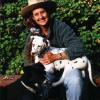

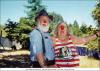

Merl and Melvin Seals at the "Comes A Time" benefit tribute to Jerry Garcia at the Greek Theatre in Berkeley, 9/24/05. Photo: Bob Minkin www.minkindesign.com © 2008
The Dead Family lost another one of its finest when keyboardist extraordinaire Merl Saunders died on Friday, October 24, at the age of 74. Although a stroke more than six years ago effectively ended his musical career (and left him unable to speak), his radiant smile still lit up every room he entered, and every gig by one of his many musical friends he attended. I’ll never forget the big “Comes A Time” concert at the Greek Theater a few years ago where he shared a piano bench with Melvin Seals (from the latter day Garcia Band) and, beaming every second under his trademark leather cap, managed to play a few notes with his working arm… No doubt about it, this cat had the music in him!
Of course Merl will forever be associated with Jerry Garcia—it was a great partnership that produced an incredible variety of music in many different groups and situations through the years, but began at a little nightclub in the Fillmore district of San Francisco called the Matrix. You’ll forgive me if I lift/adapt a discussion of that early group and of Merl’s background from the un-cut version of my biography of Jerry, called Garcia, published in 1999, and based in part on hours of interviews with Merl:
[Jerry and Merl hooking up together musically] was an outgrowth of the Monday night jams with [keyboardist] Howard Wales — somewhere along the line, Wales dropped out, and his spot was filled by Saunders. Garcia still played gigs with Wales from time to time, and he helped Wales make a record called Hooteroll?, which came out in late 1971, but once the quartet of Garcia, Saunders, John Kahn and [drummer] Bill Vitt got together, that group became Garcia's main musical focus outside of the Dead.
Saunders was several years older than the other guys in the quartet and was already a journeyman musician by the time he hooked up with Garcia. Like so many African American keyboardists of his time, Merl grew up playing music in the church; in his case a Methodist church at Geary and Webster in San Francisco, “though I also used to sneak over to another church where the holy rollers were,” he added conspiratorially. As a teen, he and his family lived in a large house in Haight-Ashbury — in fact, Merl says that during the Summer of Love era, long after he'd moved out, his mother would sometimes call the police to complain about the noise being made by local hippie bands; and his father, who worked as a doorman at 2090 Pacific, actually knew Garcia before Merl did!
As a teenager, Merl soaked up all the music he could — jazz, blues, R&B — and spent nearly every waking hour practicing the piano. “The thing about growing up in music during my generation is you had to learn how to play everything,” he said. “I listened to Stan Kenton, B.B. King, Count Basie, Duke Ellington, down to Clarence Gatemouth Brown, Ivory Joe Hunter and Louis Jordan, who doesn't get the credit, but he was the first rapper. Slim Gaillard — he came to my high school and played piano with his hands backwards; I thought he was amazing. I used to love Saunders King — my name is actually Sanders, but I changed it because I liked the sound of Saunders King. My mom and dad used to take me to this supper club and I'd hear Saunders King at 10 or 11 o’ clock in the morning, back when Fillmore Street was like 125th Street in New York. I used to see Dinah Washington there in the afternoons. People like Duke Ellington and Harry James would play at the Warfield or the Golden Gate Theater, and then later I started going to the jazz clubs — Basin Street West, the El Matador, the Jazz Workshop, the Blackhawk. I saw some of the greatest musicians in the world in those places, and it made quite an impression on me.”
Then, “when I was in Paris in the service, I heard Jimmy Smith, which really got me interested in the organ. Later on, he and I became friends and he showed me the fundamentals of playing organ.” Saunders was also influenced by Hammond B-3 masters like Jimmy McGriff and “Brother” Jack McDuff. Merl spent several years on the road playing in an organ trio, eventually settling in New York City, where he did session work and played on commercials. He also had a stint conducting a band at the Riviera Hotel in Las Vegas before he moved back to the Bay Area. There, he hooked up with Michael Bloomfield, and through him met Kahn, Vitt and Garcia. Their first work together was at Wally Heider's on an album by a singer named Danny Cox.
“The chemistry between us was instant,” Merl noted. “I'd hear Jerry playing and the music was going one way and I'd hear him sort of drifting off in this other much cooler direction, so I'd be right there with him, and we'd sort of smile at each other, like, 'Hey, this is happenin'. If there's two people going one way, even if it's not the regular way, then there's no mistake. And John Kahn was following along with us, too.”
In Saunders' memory, his first couple of Matrix gigs with Garcia and Vitt were without John Kahn and very loose. But once the quartet started playing together regularly at the Keystone Korner and the New Monk in Berkeley (later renamed the Keystone Berkeley), the music began to go in all sorts of interesting directions. Whereas the gig with Howard Wales was almost completely free-form and all instrumental, the quartet with Merl jammed out on some of his own funk-oriented original songs, Motown and R&B tunes (usually sung by Garcia), and jazz standards, which were something new for Garcia.
“That required a whole lot of quick education for me, and Merl was responsible for that,” Garcia said. “He really helped me improve myself on a level of harmonic understanding. Playing with him required a whole different style from three-chord rock 'n' roll or even 10-chord rock 'n' roll; it was a whole different thing. But what I was able to bring to that situation was the ability to use odd-length runs in conventional formats. I was able to use ideas that were rhythmically uneven because of working in odd time signatures so much with the Dead.”
Garcia said that working with Merl also taught him a great deal about musical structure: “He filled me in on all those years of things I didn't do. I'd never played any standards; I'd never played in dance bands. I never had any approach to the world of regular, straight music. He knows all the standards, and he taught me how bebop works. He taught me music. Between the combination of Howard and Merl, that's where I really learned music. Before it was sort of, ‘OK, where do I plug in?’ I picked up the adult version of a music attitude from those guys."
 Merl says that Garcia was an eager and gifted pupil with an insatiable desire to learn new things, whether it was working off a relatively easy tune like “My Funny Valentine” or some incredibly complex number by the supremely gifted pianist Art Tatum, who became one of Garcia's favorite musicians. “I saw Art Tatum play when I was about 15 years old and I got so disgusted I stopped playing piano,” Saunders said with a laugh. “I thought, 'What's the point?' He was so amazing you could never hope to be that good in your wildest dreams. I was hurt; I was crushed. But he was a genius, and of course I came to appreciate him more, and I actually studied him a bit. I managed to learn a few of his runs and I'd be there warming up on this stuff and Garcia would be saying, ‘Hey man, what's that run?’ ‘That's Art Tatum.’ And we'd go over them together. Then we'd be out at the Keystone in the middle of a song and all of a sudden I'd hear him doing an Art Tatum run, and I'd look over and he'd have this big smile on his face! Man, when Jerry would get on something, he'd keep going with it until he got it. He'd stumble through it at first, but he understood music so well and he had such a good memory that he could eventually get almost anything he tried down. And getting down Art Tatum is not easy — on piano or guitar.”
Merl added a couple of organ overdubs to the Dead’s live “Skull & Roses” album and Garcia played on two of Merl’s early ’70s solo albums on the Fantasy label , Heavy Turbulence and Fire Up (since condensed to a fine single-CD). The mid-1973 version of what was usually called the Saunders-Garcia Band (but actually had no formal name; we all just called it “Jerry and Merl”) was documented beautifully on the live double-album Live At Keystone (released later, with bonus tracks, as three separate CDs). In early 1974, saxophonist Martin Fierro (who also passed away within the last year) joined the group and brought in an even greater emphasis on jazz and Latin flavors. With the addition of drummer Ron Tutt, the band became known for a period as the Legion of Mary. Those groups—without and with Tutt—are captured on the Pure Jerry series release Keystone Berkeley September 1, 1974 and Rhino’s The Jerry Garcia Collection Vol. 1: Legion of Mary. Listening to all those CDs you can hear the full range of Merl’s keyboard genius, from beefy B-3 lines, to funky clavinet, soaring synth and shimmering electric piano. Merl also wrote many fine tunes for the group, including “Soul Roach,” “Keepers,” “Wondering Why,” “Manchild” “Save Mother Earth,” and others.
Jerry and Merl (and John Kahn) next played together in Reconstruction (January through September 1979), the jazzy, horn-fueled band that also featured saxophonist Ron Stallings, trombonist Ed Neumeister and drummer Gaylord Birch; a totally different-sounding aggregation with a repertoire that had very little carryover from Jerry’s (or Merl’s) previous groups. “The approach was to play jazz and rock together but still be danceable,” Merl told me. “It was a great band for a while. Jerry liked that it gave him a totally new structure to work with, with these great horn players and a different set of tunes. These were really excellent musicians. And because they came from outside the Grateful Dead world, they related to Jerry as just another player, not a ‘star.’ I remember after one of our first gigs, Gaylord Birch, who had this long history playing with the Pointer Sisters and Edwin Hawkins and all these other groups, but didn't know about the Dead or Dead Heads, came up to me and said, ‘What was happening up there? What was that roar I heard coming up to the stage?’ And I said, ‘Oh, that was when Jerry moved his leg!’” he laughed.
It would be a number of years before they would once again collaborate on a musical project together, but when they did it was an interesting one: Merl became the musical director of the 1985 TV series The Twilight Zone, and he brought in the Grateful Dead to re-work the famous theme, and both Garcia and Mickey Hart also contributed quite a bit of incidental music and effects to different episodes, under Merl’s direction.
A year later, though, something happened that really brought the depth of their friendship into focus: When Jerry nearly died in the summer of 1986 after slipping into a diabetic coma, it was Merl more than anyone else, who literally sat by Jerry’s side and helped him regain his musical gifts—which had become scrambled and elusive following the coma—by patiently re-teaching him the fundamentals, rebuilding his skills a little at a time. And even before he was ready to attempt to play, Merl helped him get some of his strength back: “I'd take him for a walk. We'd take 10 steps, then take 10 steps back. His attitude was great. He wanted to get better, but he was scared, too. He got tired very easily, but he never really got discouraged. The most he'd say would be, ‘Oh man, this is harder than it looks!’”
Once Garcia picked up a guitar, “It came back very slowly,” Merl said. “He had to learn chords all over again and he had a lot of trouble remembering how to do even the simplest stuff. And I didn't want to push him. ‘Man, I'm tired.’ He'd been playing for five minutes. ‘OK, that's fine. Put it down. Let's go for a walk.’ And we'd do that for a few minutes until he'd get tired. We'd talk about music. I'd tell him about songs I was working on and that would get his mind going. We'd talk in musical terms. And slowly he started to get his strength back. But it sometimes took an hour or two for him to get even a simple chord down. Then, as we got farther into it, some things started to come back to him a little, but it took a lot of work. The first song he wanted to learn again was ‘My Funny Valentine.’”
The last major project Merl and Jerry worked on was Merl’s wonderful instrumental album, Blues from the Rainforest in 1990, which Merl dubbed “an enivonmental new age musical suite.” What started out as a duo concept to feature just Merl and percussionist Muruga Booker, was soon expanded to include Garcia and others. “When I wrote [the title song] I also heard a part for Jerry in my head,” Merl told me in a 1990 interview for The Golden Road. “So after I had about half the album done, I sent him a rough sketch of what we were doing and, man, he couldn’t wait to come down and work on it…It’d been 15 years since we worked on album together." Besides being on the title track, Jerry is also prominent on the beautiful “Blue Hill Ocean Dance” which Merl said “became a sort of odyssey under water. Jerry did his MIDI guitar with a flute sound, and it sounds like both of us are just scooting along the bottom of the ocean!”
Aside from his work with Jerry through the years, Merl always kept busy playing music—touring with various bands (such as The Rainforest Band, which he formed after the success of Blues from the Rainforest) and playing sessions with a wide variety of folks through the years, including Bonnie Raitt, Taj Mahal, Tom Fogerty (who was a member of the Saunders-Garcia Band for a while), Robert Hunter, The Dinosaurs, Jerry Miller, Norton Buffalo and others. He led the big jam at the Haight Street Fair for a quarter century, and he was also known to play beautiful solo piano in small clubs and hotels; he could truly do it all!
There’s SO much we’ll miss about Merl, but mostly it’s the joy and spirit he brought to everything he did. He was truly one-of-a-kind!
dead comment
VERY nice, Blair.
Toodle-oo, Merl
Thank you Merl
Thanks, Blair
Boulder Creek
RIP - Rock in peace brother Merl
Keepers
Really nice article, thank
Well ...
Good-bye
recordings...
Merl Saunders post
The Great Gig In The Sky...
Merls Passing.
True Legend - great article
Thank You, Merle !!!
The kindest musician I've ever met.
Blair - thanks for sharing the history here with us
beautiful shots
Merle
RIP Merl
What a great little tribute...
soulful musical spirit
jerrygarcia.com?
So long Merl!
no words ..
Jerry releases
Once some final legal hurdles are overcome, hopefully soon, there will be more Jerry releases. As they say in Italy, pazienza! Patience! All good things in all good time...
With any luck, too, this site will become the clearing house for Jerry news and features, as well. Stay tuned...
The Legion of Mary is together again.....
I'm sorry
thanks merl RIP
You could post more pictures of Merl if you want to
Thanks, Blair
Remembering Merle remembering Jerry
For Merl
 "The task is, not so much to see what no one has yet seen; but to think what nobody has yet thought, about that which everybody sees. ." - Erwin Schrödinger